· updated
What separates B, C and D breakers
What actually separates B, C and D breakers: the magnetic trip threshold, not overload protection. With a trip curve and some of the math behind it.
I once had a B16 trip on a circuit feeding a fairly large transformer, even though the calculations showed no overload at all. The transformer’s inrush current briefly crossed the magnetic trip threshold and the B breaker did exactly what it’s supposed to do: cut the power right away. A C-type in the same spot would have ridden that inrush out without a problem. B, C and D differ in one thing: the multiple of the rated current at which the breaker trips instantly. They don’t give more or less protection overall.
Two trip mechanisms in one housing
A circuit breaker has two separate trip mechanisms that work independently of each other.
The thermal trip is a bimetallic strip that heats up as current flows through it and, past a certain temperature, bends far enough to trip the switch. It protects against overload, but reacts slowly, somewhere between seconds and minutes depending on how far the current exceeds the rated value.
The magnetic trip is a coil that, given enough current, instantly pulls in an armature and trips the switch mechanically, regardless of temperature. It protects against short circuits and typically reacts within a few milliseconds.
B, C and D only change the magnetic side. Thermal overload protection is identical across all three types, fixed by the standard DIN EN 60898-1 no matter what the letter says.
The three ranges
For the magnetic trip, the standard defines three multiples of the rated current In within which the breaker is guaranteed to trip instantly:
| Type | Trip range | Typical use |
|---|---|---|
| B | 3 to 5 × In | Lighting, residential socket circuits, long cable runs |
| C | 5 to 10 × In | Small motors, transformers, ballasts |
| D | 10 to 20 × In | Large transformers, motors with high inrush current, X-ray machines |
That makes B the most sensitive type. A device with a noticeable inrush current, a larger transformer or an electric motor, say, can trip a B breaker even when nothing is actually wrong, simply because the brief inrush spike shoots past three times the rated current. C tolerates that spike up to ten times, D up to twenty.
LED lights on a B10
With LED lights that doesn’t always work out. Every LED light has a small power supply, the LED driver and its input capacitors charge all at once when you switch on. That current spike is very short, but with some drivers it reaches many times what the light draws in normal operation.
On a B10, the magnetic threshold sits at 3 to 5 × 10 A, so 30 to 50 A. A driver with a high inrush current can get close to that on its own and several lights on the same switch add their spikes together. The breaker then trips at switch-on, even though only a few amps flow once the lights are running. How high the spike gets depends on where in the sine wave the switch closes, which is why a circuit like this often trips only now and then and is annoying to track down.
Many LED driver manufacturers list in the datasheet how many drivers can sit on a B or C breaker of a given size. For a lighting circuit with lots of fittings, check that number before planning. If it doesn’t fit, you can split the lights across several circuits, put an inrush current limiter in front of the group or switch to a C10. A C10 only protects reliably if at least 100 A flow in a short circuit, ten times the rated current. On long cable runs that isn’t a given.
The trip curve
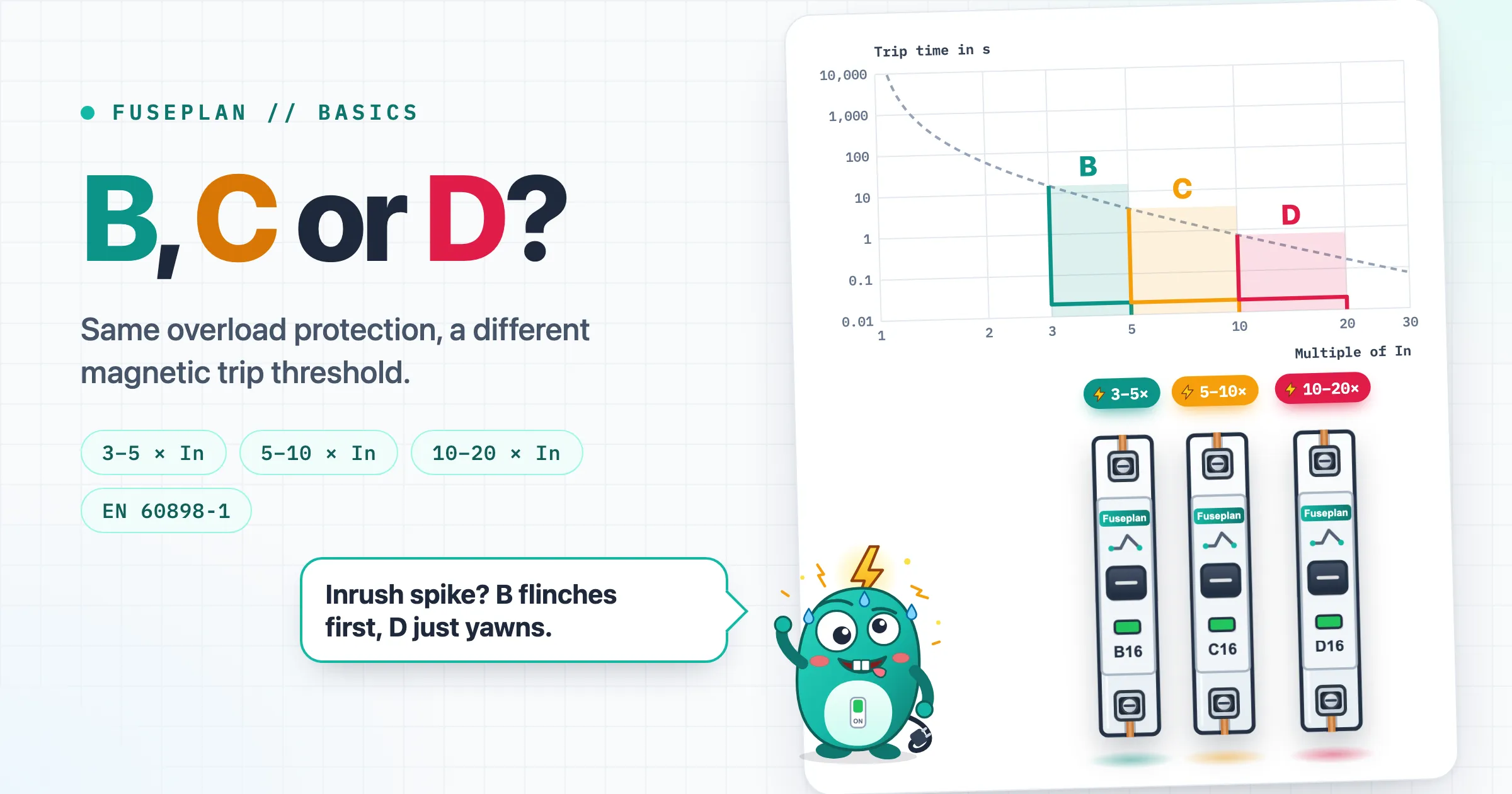
The sloped grey line is the thermal range, shared by all three types: the stronger the overcurrent, the faster the trip, but still on the order of seconds, not milliseconds. The three colored steps are the magnetic range for each characteristic. Once the curve reaches that step, the trip time drops to a fraction of a second. The only difference between B, C and D is at what multiple of the rated current that step begins.
A bit of math on the thermal side
The heating power in the bimetal follows Joule heating, . The breaker needs a certain amount of heat to reach its trip temperature. Ignoring heat loss to the surroundings while it heats up, the trip time works out to approximately:
Here is the overload factor, the multiple of the rated current. The shows up because at exactly the breaker sits in thermal equilibrium and never trips; only the current above actually contributes to net heating.
This approximation is why the curve drops so steeply: double the overload factor and the trip time falls to roughly a quarter. Real bimetallic trips also shed some heat to the surroundings while they heat up, so actual curves run a bit flatter than this simplified formula, especially at small overload factors close to .
The standard pins down two concrete test points: at , the breaker must not trip within the conventional time (one hour up to 63 A, two hours above that). At , it must trip within that same time. The manufacturer’s allowed tolerance sits between those two values, so a real device’s curve can look a bit different from the schematic above.
Why not just always use D
A D breaker trips on nuisance faults less often, which sounds like the safer choice at first glance. But in an actual short circuit, a D-type lets through significantly more current before it clears, up to twenty times the rated current. The cable behind it has to survive that higher short-circuit current for the brief trip time without taking damage and a cable sized for B or C doesn’t get that for free. D belongs where the high inrush current genuinely calls for it, not as a blanket fix for nuisance tripping.
How close it can actually get is something you can calculate. A cable only survives a short circuit for a certain time before its insulation takes damage and that’s described by the same kind of formula as above, just for the cable instead of the bimetallic trip:
is the cross-section, a material constant for the insulation, the short-circuit current. Pit breaker and cable against each other and drag the slider:
With thin cross-sections and high fault currents, the cable curve dips below the trip curve fast, especially with D. Cable sizing under DIN VDE 0100-430 is meant to prevent that case. Breaker and cable cross-section have to match each other.
Which type goes where
B is the default for socket and lighting circuits in flats and houses. It clears a short circuit from three to five times the rated current, so the disconnection condition is easiest to meet even on long cable runs. I only reach for C where inrush current would otherwise trip a B breaker regularly: motors, larger transformers or a lighting circuit with many LED drivers whose datasheet rules out a B type. The cable then has to be short enough for ten times the rated current to flow in a short circuit. D stays reserved for cases where a specific device with a high startup current would otherwise trip regularly and only when the cable is actually sized for it.
Comments
Write a comment